| Newsletter Home |
OPERA? IT’S BACK!
Opera, live at the Mt. Gretna Playhouse, is returning next year.
“Mt. Gretna’s Arts Council is wonderful to work with and did
their best to make our first experience—with Verdi’s Otello—a
good one last summer,” says Center Stage Opera’s Kathryn Foster.
Her Harrisburg-based company is the only traveling troupe in the area, and
they hope to make Mt. Gretna a regular stop on their summer schedule. “We
were well received,” she says.
Kathryn will meet with the council next month to review plans for their
June 2, 2007 performance, scenes from Falstaff, a comedy that was Verdi’s
final opera. Other performances planned by Center Stage Opera (see http://www.csopera.org/home.htm
) include Lucia de Lammermoor in March and Pagliacci/Cavalleria Rusticana
in November) at other locations throughout the region.
STAYING CLOSE ON NEW YEAR’S EVE
You won’t have to drive far to celebrate New Year’s Eve in
Mt. Gretna. In fact, depending on where you live, you can walk.
LeSorelle Café and Timbers Dinner Theater are both offering New Year’s
Eve party packages.
LeSorelle’s $50 per person affair, starting at 8 p.m., features garlic
roast beef tenderloin or flounder stuffed with crab imperial entrees—plus
appetizers, soup, salad, dessert and a complimentary glass of wine. The
Timbers’ $22 package includes dinner music by jazz pianist Andy Roberts
and a six-piece band after dinner, with a buffet featuring roast turkey,
country ham and hot beef, plus assorted fruits, vegetables, salads and desserts,
from 7 p.m. until 1 a.m. (Reservations: LeSorelle 964-3771; Timbers 964-3601.)
STUFF YOU PROBABLY WON’T READ ELSEWHERE
[] Val Sarabia, a national contestant in The Wall Street Journal’s current “Dartboard” contest—matching talented amateurs against the Journal’s dart-tossing stock selections—was in second place last week. Follow the Mt. Gretnan’s adventures in the Journal’s weekend sections of the Harrisburg Patriot and Lancaster Sunday News.
[] Christmas Eve candlelight services begin at 7 p.m. and 11 p.m. at Mt. Gretna’s United Methodist Church. The regular church service begins at 10 a.m. All are welcome.
[] No, there won’t be any more Christmas tree drop-offs at Governor Dick Park along Rte. 117. (Park officials say too many folks left trees with lights, tensile and other decorations still attached, clogging their grinding machines.) However, West Cornwall Twp. have announced that their residents will be able to drop off unbagged, ornament-free trees at a specially marked area behind the township building, 73 S. Zinns Mill Rd., until Feb. 1. Crews in Mt. Gretna boro and the Campmeeting will pick up trees for residents in their communities.
[] Planner Lee Meyer invites Mt. Gretnans to lend their ideas to a comprehensive
plan now taking shape for Lebanon County. Details appear online at http://lebcocompplan.net/;
next meeting in the series of public sessions on the plan begins at 3 p.m.
Jan. 16 at the county municipal building.
[] The Governor Dick Nature Center is closed, but the Governor Dick Park
Newsletter remains open for business year ‘round. Add your name to
the free subscription list for news about upcoming programs, special meetings,
exhibits, nature studies and other events. See www.parkatgovernordick.org
or e-mail governordick@hotmail.com.
[] And don’t forget about those Winterites. The folks who remain in
town while others skip off to Florida have no intention of just sitting
around the fire this winter. They’ll be at it again in February, with
a birthday celebration Feb. 6 honoring founder Magi Stroh at the fire hall,
starting at 1 p.m. Everybody’s invited—all ages, all genders,
on first Tuesdays except January, straight through until April.
[] Need a cleaning lady? Ruth Taft, who serves several Mt. Gretna residents and can provide ready references, is looking for more work nearby. Give her a call: 717-279-1190.
[] Too busy to bake? Call an artist. Eva Bender’s European style cookies include Swedish gingerbread hearts, Russian kisses, Finnish sticks, Italian hazelnut Biscotti and more: 964-3727; Barbara Acker’s creations include cherry, pumpkin, pecan and apple pies, coconut cake, sweet rolls, breads of all types and, of course, the sticky buns that made Barb famous: 964-1950.
THE EXPLORER THEY THOUGHT WAS A SPY
Chatauquan Bill Gifford will soon have a new book out. The Washington,
D.C. native moved here a few years ago, attracted in part by his enthusiasm
for mountain biking. “I really love the place and the people. It’s
such a diverse, tolerant community, and so creative in spirit,” he
says.
Bill now divides his time between Mt. Gretna—where he’s often
seen out walking Theo and Lizzy, his two coonhounds—and New York City,
where he’s the features editor for Men’s Journal.
His book, Ledyard: In Search of the First American Explorer, recounts the
story of 18th century explorer John Ledyard, who helped Jefferson come up
with the idea for Lewis & Clark’s Expedition. It describes not
only the explorer’s three expeditions, including Captain Cook’s
voyage to the Pacific, but also his reputation as a charming raconteur and
ladies’ man, and his trip to Siberia where he was arrested as a spy.
Bill says he wrote the whole thing in his office, formerly the sleeping
porch at his Princeton Avenue cottage. “Mt. Gretna is like a secret
national treasure,” he says. “I can’t decide whether to
tell the world about it, or keep it a secret for the select few.”
The book won’t be out until Feb. 5, but you can place advance orders
online now through Amazon.com.
NUMBERS
9 Degrees. The only mark on the thermometer guaranteed to stop diehard cyclists
like Bill Care, determined to squeeze every ounce from short winter days.
That’s the mark that finally convinced competitive cyclist Bill and
a group of friends to abruptly abort their 30-mile ride from Elizabethtown
to Pine Grove one frosty January morning. “People looked at the forecast
and told us, ‘You guys are out of your mind.’
“A mile or so into the ride,” says Bill, “we agreed they
were right. We turned around and headed back home for coffee and a hot breakfast.”
That doesn’t happen often, however. Bill’s been cycling for
30 years and racing competitively for the past six. He practices almost
every day, and it pays off. Last summer, at the Seven Springs, Pa. competition
for cyclists age 55 and older, Bill placed 15th among 81 of the nation’s
top racers.
30 Hours some hunters waited at Governor Dick Park without glimpsing a
single deer in that limited four-day hunt last month.
At nearby Gretna Springs, Earl Hurst, who supervises a two-mile stretch
bordering the park, says he hasn’t seen a single deer all year. “Normally,
the hunters who live here bring back six or eight every year. This year,
nothing,” he says.
Although totals won’t be known for several weeks (and the statewide
tallies won’t be ready until mid-March), Pennsylvania’s deer
population does indeed appear to be declining. Locals speculated that the
Governor Dick hunt may have yielded only about 15—a sharp contrast
to the 55 taken in 2005 when 42 deer—never having seen hunters before—were
claimed on opening day.
Just how many deer once roamed the 1,105-acre site? Forester Barry Rose,
observing the stubble left by grazing deer several years ago, estimated
the population at “more than 100.” But a forest that size, he
said, can really support only about 20 to 35 deer.
If the numbers add up—with 55 in 2005 and 15 or so this year—Governor
Dick’s deer population may now be close to ideal. But only temporarily.
Left unchecked, herds can double every two or three years, a Department
of Environmental Resources official told us.
This year’s meager bounty will likely scuttle plans for another hunt
at the park in 2007. Under a provisional five-year ruling, the hunt was
a court-ordered exception to deed restrictions by donor Clarence Shock,
whose will banned hunting at the site.
Hunt coordinator and park board member Chuck Allwein—now pursuing
a state grant to set up giant fenced areas that will protect saplings and
allow the forest to continue its slow regenerative process—says a
deer density workshop and field survey next spring will determine whether
another hunt is necessary.
That may be a difficult test, however. Veteran hunters say numbers alone
don’t tell the whole story: “Yep, there are fewer deer,”
they say, “but the ones that are left know how to survive. They don’t
even leave tracks in the snow.”
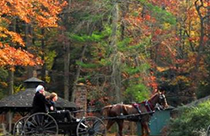
1,000 People who now use the 12.5-mile Lebanon Valley rail-trail through
Mt. Gretna on a typical fall day, when leaves are at their peak. Hikers,
bicyclists, horseback riders and joggers usually enter the trail from one
of three “trailheads” located at Lawn, Colebrook and Cornwall.
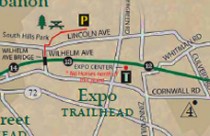
If all goes well, there could be yet another local trailhead, near the Alden
Place development off Rte. 72. Coordinator John Wengert has asked for a
$117,000 grant to build a new access point with parking for 25 cars near
the Rte. 72 overpass. On a typical weekend, that’s where, even without
a parking lot, cars are already assembling—a testament to the trail’s
growing popularity.
By spring, with signs now up along the new trail spur leading to Mt. Gretna,
we could see even more outdoor enthusiasts stopping by to sample music,
culture. . . and probably pizza.
“GRANDDAD, I NEED A BUSINSS PLAN”
You’ll see him around Mt. Gretna, sometimes standing outside the
playhouse, absorbed in a Gretna Music concert. Or out walking his dog. Or,
once, dressed up in a tuxedo, serving refreshments to thirsty patrons on
the annual August house tour.
Two years ago, he signed up for an online course in theme park design, offered
by one of the top creative minds at Walt Disney Imagineering. Joining other
electronic wizards from around the world, Jacob Miller—summertime
visitor to Mt. Gretna—became part of a worldwide team, electronically
linked but geographically separated. No matter. Online, distance doesn’t
matter. Neither, apparently, does age.
Soon after the team began working together, Jake, as he’s known to
friends, caught the interest and attention of Steve Alcorn, 50, who runs
the Orlando, Fla.-based course sponsor, Alcorn McBride, Inc.
The CEO invited Jake to meet with him in Florida, the first such offer Alcorn
has ever extended to anyone on the far-flung teams, normally made up of
veteran designers and engineers.
“I’ll have to ask my parents,” said Jake, who was 12 at
the time.
The Florida meeting, scheduled to last 30 minutes, took four hours. Alcorn
concluded the session by offering Jake an internship.
A classical pianist, Jake studies music theory and composition at Lancaster’s
Pennsylvania Academy of Music, has already talked with admissions officers
at MIT, and—as part of a home schooling curriculum—is gobbling
up calculus and other online courses offered by the University of Missouri.
Now 14, he also runs his own company, producing color-coordinated accessories
for his dad’s Poconos-based outdoor adventure firm.
What’s next? He’d like to incorporate, but he needs help with
his business plan. Naturally, he turned to his granddad, Ron Fink, a Lancaster
businessman who for the past five years has been enjoying with his wife
Joyce the Lafayette Avenue cottage “Thistledew.”
Ron’s now at work on Jake’s business plan.
QUESTIONS READERS ASK
[] What happens to the profits from the end-of-season beach party at Mt. Gretna Lake? Nobody seems to know who the money is donated to.”
<> Since 2004, the “Big Band Bash at the Beach” organizers
Karen and Ceylon Leitzel, who simply love dancing to the music, have donated
their leftover profits to various groups in Mt. Gretna. They started with
contributions to the fire company, United Methodist Church and the Wing
and a Prayer chorus. Since then, they’ve added others: Lawn Ambulance,
the Bible Festival, Heritage Festival and others.
“Karen and I are always listening for specific needs. That’s
how we decided to include the Heritage Festival, since they had a $700 shortfall,
last year. Does anyone have other suggestions? We’re always open to
ideas,” says Ceylon, who was recently named “jeweler of the
year” at the Pennsylvania Jewelers Association’s 100th anniversary
convention. (It was his second such honor from the group, and Ceylon—among
more than 700 jewelers statewide—is the only person ever to win it
twice.)
[] Does PennDOT plan to put rumble strips the edges of Rte. 117 when the resurfacing work begins next year? They did that along Butler Road and Rte. 241 recently, creating a hazard to bicyclists because it limits the road surface and forces bikers onto the roadway. (Besides, if someone falls asleep while driving on Butler Road, rumble strips aren’t going to help!)
<> Roadway planners tell us that PennDOT is now installing rumble
strips only on roads where the accident history—in terms of both number
and severity—justifies them. District traffic engineer Dave Mallin
reports that PennDOT does not intend to install edge line rumble strips
on Rte. 117 “unless warranted in specific locations.”
Lebanon County highway planner Tom Kotay adds that the Butler Road strips
were installed “because we have a growing accident history there,
with vehicles hitting trees and driving into catch basins. And the rumble
strips do help.” Tom says rumble strips became more widespread after
the federal government began providing funds as part of highway safety improvement
program. “If the shoulder is wide enough and rumble strips are employed,
I don’t think it hinders bicycle traffic. But the reader is right,
though, about Butler Road,” says Tom.
[] How did all those rocks at the waterfall along Rte. 117 get there?
<> “It’s the question we’re asked most often,”
says Janet Rudd. Soon after she and her husband Jonathan, a Harrisburg attorney,
bought the 18-acre property in 1995, they discovered that the site was loaded
with boulders and began putting them to use. “People stop by and ask
us that all the time, sometimes three or four times a day on summer weekends.
I don’t mind,” she says. “They’re usually very friendly
and just want to stop, talk and occasionally take pictures.”
Janet says she has no idea of how many gallons of water tumble over the
waterfall each day, but so far the flow hasn’t slowed much, even during
dry spells. “This area is full of underground springs,” she
says. Full of rocks, too, her husband told us. “It’s amazing
what you hit on that hill once you start digging below the surface.”
[] What were they doing at the lake this year, down by the dam? It looks
nice, but weren’t they supposed to be finished by Memorial Day?
<> As we reported last March, the project is a “proactive effort in cooperation with the Pennsylvania Department of Environmental Resources to enhance the safety and assure continued viability of the dam.” An unusually wet spring—especially in April and May—hindered some of the dirt compaction work, extending the project’s timeline. But the contractor expects to complete finishing touches next spring.
[] Has there ever been a workshop on miniatures in Mt. Gretna?
<> Summer programs coordinator Kathy Snavely says, as far as she
knows, there’s never been a class on miniatures (furnishings for doll
houses), “but we’re always open to suggestions.” Plans
are underway for a Victorian Week next year, she says, plus additional offerings
on wellness, global warming, cutting edge sciences and more.
Have a summer program idea you’d like to suggest? Drop Kathy a note
at info@lightkeeper.net.
LADYBUG! LADYBUG! FLY AWAY. . . er, TO THE GOV. DICK HOTEL
From time to time, readers have asked about the sudden, inexplicable invasions of ladybugs in Mt. Gretna. Why ladybugs? Why so many? Why at only certain times of the year? And why here?
We think that we may have an answer. Chuck Allwein, a former biology teacher who volunteers at the Governor Dick Nature Center, ran into a couple of entomologists the other day. Two insect experts, Paul Schaefer, from the USDA office in Delaware, and Roger Williams, an Ohio State University professor, have been fascinated by the attraction to the Governor Dick tower by Harmonia Axyridis, otherwise known as ladybugs.
Schaefer and Williams theorize that ladybugs, which enjoy hanging out in the darkened crevices of rocks, look on the 66-foot concrete and steel Gov. Dick Tower as a giant rock, a kind of four-story hotel that, unless temperatures drop severely, is an almost perfect “wintering over” spot. The entomologists first discovered the tower’s popularity among the beetle crowd in 1994 and have been returning every year to chart their activities.
What do ladybugs do all winter long? Huddle beneath the steel ladderways,
in spots shielded almost totally from light. (It’s a rock, remember.)
They squeeze into darkened spots—the colder it gets the closer they
huddle—until warmer temperatures return. On sunny days, they’re
apt to be out circling Mt. Gretna, soaking up sun and enjoying the good
life. Which explains why one reader, discovering them in her hot tub one
warm day last December, sent us a note saying, “I didn’t realize
they knew how to do the backstroke.”
Kindest regards,
Roger Groce
P.S. Although Thanksgiving is the time of year when we express gratitude,
Christmas is the time of year when we often show others how much we appreciate
them. In Mt. Gretna—where most of the homes are made of wood—no
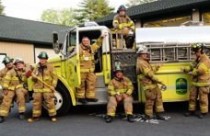
one is more appreciated than our firefighters. Every alarm means that someone,
somewhere is dropping what they’re doing and putting their training,
courage and commitment to work on our behalf. How do we ever thank them
enough? We can’t. But we can make a start with that donation envelope
that recently arrived in the mail. They appreciate our support. We can never
adequately repay them for theirs.